Showing posts with label Genesis 1. Show all posts

Saturday, February 21, 2009

Don't Get Mad, Get GLAD: Plant-based Diets

This is part 7 of my research on global food movements entitled
GLOBALIZATION: It's what's for dinner

Global food movements making a difference: PLANT-BASED DIETS

"Eat less meat." That was the essence of the message by Dr. Rajendra Pacauri, chair of the United Nations Intergovernmental Panel on Climate Change in September. While the comments by this Nobel Peace Prize recipient may be "the most controversial yet," they represent one of the most practical things individuals can do to tackle global warming. [38] "In terms of immediacy of action and the feasibility of bringing about reductions in a short period of time, it clearly is the most attractive opportunity," Pacauri said. "Give up meat for one day [a week] initially, and decrease it from there."
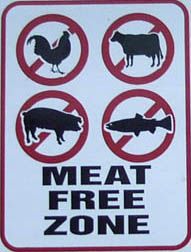
The comments by this vegetarian bear testimony to another global food movement - plant-based diets, which include Vegetarianism, Veganism, Raw/Live Foodism, and Fruitarianism. [39] Each has received increased attention as a sustainable dietary choice, which has health benefits personally and environmentally.

Though the history of plant-based diets is a long one, John Robbins brought it to the forefront of the American conscious in 1987 with his book, Diet For A New America. Now an international bestseller, the book clearly presents how food choice affects personal health and happiness, but also the future of life on the earth. By detailing health risks of meat consumption, corruption in food production, and animal abuses in the food industry, he advocates for a plant-based, vegan diet, and has inspired many to eat less (if any) meat.

Robbins drew much attention to himself and to his first book as the only son of Irving Robbins of the Baskin-Robbins ice cream empire. Though groomed to follow in his father's footsteps, he chose to walk away from the company and the immense wealth it represented to "pursue the deeper American Dream. . . the dream of a society at peace with its conscience because it respects and lives in harmony with all life forms. A dream of a society that is truly healthy, practicing a wise and compassionate stewardship of a balanced ecosystem." [40] While Robbins really gave credibility to the growing vegan movement, he also re-started the vegetarian movement in the United States. [41]

The history of plant-based diets is really as old as history, and rooted in all religious and philosophical traditions. [42] In terms of human anatomy, some doctors are advancing the physiological facts that humanity was created as natural herbivores, not carnivores. [43] This is confirmed in the creation story of the Judeo-Christian faith where a plant-based diet is prescribed for humans and for animals in Genesis 1:29-30, with the harmonious co-existence of humanity and the environment being deemed by the Creator as "very good" (1:31).

Among religious groups in Egypt around 3200 BC, a vegetarian ideology was practiced with abstinence from flesh based upon karmic beliefs in reincarnation. Abstention from meat was also central to such early religions as Hinduism, Buddhism, Zoroasterianism, and Jainism, which all hold doctrines of non-violence and respect for all life forms. While wishing to avoid animal cruelty, philosopher and mathematician Pythagoras encouraged vegetarianism as a key factor in peaceful human co-existence, putting forward the view that slaughtering animals brutalized the human soul. He also saw the health advantages in a meat-free diet.

Other ancient Greek thinkers, Socrates, Plato, and Aristotle also favored a vegetarian diet and advocated a "natural" life that did not involve animal cruelty. Though such ideals found very limited sympathy within the brutality of Ancient Rome, vegetarianism spread throughout the Roman Empire from the 3rd to 6th centuries among those influenced by Neo-Platonist philosophy, a progression from the teachings of Plato.

In the east and in the west, history clearly reveals that plant-based diets have nourished and sustained cultures all over the world for thousands of years. However, Manchester, England in 1815 is often regarded as the birthplace of the current vegetarian movement. [44]

Next week:
History of the current vegetarian movement

[38] Juliette Jowit, "UN says eat less meat to curb global warming," Guadian.co.uk, http://www.guardian.co.uk/environment/2008/sep/07/food.foodanddrink (accessed September 20, 2008).
[39] Veganism, Raw/Live Foodism, and Fruitarianism share roots with the Vegetarian movement. Due to limited space, only the history of Vegetarianism will be presented in this paper. Each, however, like Vegetarianism, developed first in Europe before influencing the dietary choices of Americans.
[40] "About John Robbins," Food Revolution, http://www.foodrevolution.org/bio.htm (accessed December 17, 2008).
[41] Michael Bluejay, "A History of Vegetarianism," Vegetarian Guide, http://michaelbluejay.com/veg/history.html (accessed December 17, 2008).
[42] Portions of this history are from "21st Century Vegetarians - Through the Ages," The Vegetarian Society UK, http://www.vegsoc.org/news/2000/21cv/ages.html (accessed December 14, 2008),
[43] Milton Mills, "Are Humans Designed To Eat Meat?" (2007), VegSource http://www.vegsource.com/articles2/mills_07.htm (accessed December 17, 2008).
[44] "Shaker-makers! Manchester Originals," International Actuarial Association - Manchester, http://www.actuaries.org/ASTIN/Colloquia/Manchester/Manchester_Originals.pdf (accessed December 17, 2008).

Sunday, March 2, 2008

Being vegan: I is for...

An oxymoron is a figure of speech that combines two normally contradictory terms. It is a phrase that makes you go, "hmm" as you consider the meaning of each separate word. Some familiar oxymorons: "jumbo shrimp", "pretty ugly", "silent scream", and everyone's favorite, "Microsoft works".

Though technically not "oxymorons", Joanne Stepaniak considers a few paradoxes in her book, Being Vegan that cause you to pause and think:
- consumers who purchase dolphin-safe tuna (what about tuna safety?)
- a bird-watcher who eats poultry
- an antiabortionist who supports capital punishment
- an animal rights activist who wears leather shoes
There is a degree of irony, she suggests, when compassion is selectively applied.

"The vegan ethic," Stepaniak writes, "applies compassion indiscriminately. In theory, vegans are concerned about every group or individual who is exploited, human or nonhuman." (p. 52) The challenge is taking that theory, and applying it to one's daily decisions.

While everyone has blind spots, vegans strive to recognize their own, and then to do something about them, because the third core principle of veganism:
I is for INTEGRITY of thought, word, and deed

Integrity is about consistency -- consistency in what a person thinks, says, and does. Integrity calls us to watch for blind spots so that no one will go "Hmm" if they were to observe our lives. Integrity is rooted in one's character, and character is "who you are when no one (but God) is watching."

In his ministry, Jesus confronted the hypocrisy he witnessed in people, especially "religious-types", who articulated high moral values but failed to live them out. "Simply let your 'Yes' be 'Yes,' and your 'No,' 'No'," Jesus said in Matthew 5:37. Do what you say. Say what you do. Consistency in character is the call for one who claims to follow Christ.

It was a year ago that I made the transition in my diet from "occasional meat eater" to "vegetarian". As my convictions were forming about why a non-meat diet was healthful for me and helpful for the environment, I came to believe that if I were to continue eating meat, I would need (I journaled) "a rationale for why I may choose meat so it does not appear to simply be at random." Finding no good reason, I was soon selecting non-meat dishes every meal. As I continued to read and to research vegetarianism and veganism, the transition to an animal-free diet (no dairy, eggs, et al) and then to an animal-free lifestyle was a logical journey of personal integrity based in compassion.

Stepaniak writes, "Compassion, according to vegan principles, accords no hierarchy of lesser or greater value to any living being. To vegans, all life is equally precious." (p. 88) And as a follower of Jesus, that is foundational to my values, too.

Much of my vegan journey has been rooted in the question = WHY? Why do I need to eat this? Why do I need to purchase this? Why do I believe this? Why do I value that? If there is a more compassionate alternative which would extend care to creation, cut down my carbon footprint, love others, and honor God, then why would I NOT want to do that?

I still have my vegan blind spots, about which I have blogged. My dietary exceptions (including chocolate cake) are one area, but there are others. I wrestle with what those exceptions and blind spots suggest to others, and how they impact my integrity as a vegan. My journey continues.

I'm taking a course at the Franciscan School of Theology this semester. I'm prayerfully considering a full-time return to seminary. The more I learn about Saint Francis of Assisi, the more I am drawn to Franciscan creation theology and eco-spirituality. Because of his love for God the Creator, Francis lived in harmony with all creation and because of his love for Jesus the Christ, he lived in the fullness of the gospel, the poverty that is found in full dependence on God. The patron saint of animals and ecology was a man of deep integrity.


In The Life of Saint Francis, Julian of Speyer notes, "Since he traced all things back to their beginning, he called every creature 'brother,' and, in his own praises, continuously invited all creatures to praise their one common Creator." (p. 401) For Francis, the key to his integrity was living in God's original intention at creation, which I highlighted last week.

"As it was in the beginning is now and will be forever" is a common phrase in the praises attributed to St. Francis. As I strive to live as a vegan follower of Christ, I find this an inspiration for my integrity = To live each day in the Garden principle of "harmlessness", envisioned by the prophet Isaiah to be re-established with the return of the Christ. "As it was in the beginning is now and will be forever."

"There is an incredibly rewarding sense of peace and satisfaction in knowing that we are doing the best we can for those most in need," writes Stepaniak. "The outcome is irrelevant because, if we embody our ethics, the influence of our short presence on this earth will continue its effects long after we are gone." (p. 60)

As you journey with integrity this Lenten season, may you in the end be found faithful.

Sunday, February 24, 2008

Being vegan: H is for...

News of the largest US beef recall last week brought to the national spotlight the abuses endured by animals in today's meat industry. Though these reports and horrific images are now fading from the media and the minds of mainstream America, reports of animal cruelty continue, and I find my commitment to the first of 6 vegan principles -- ABSTINENCE from animal products strengthened.

In light of the reported 143 million pounds of recalled beef this past week, and the 10 billion animals raised and slaughtered in the US each year for food, the second principle for a vegan...
H is for HARMLESSNESS with reverence for life

Though this may sound crude and possibly offensive to some, the primary focus of the meat industry is essentially -- death. Animals are viewed as raw materials, commodities, and product, slaughtered en masse for human consumption in the name of food.

Carol Adams in her book, Living Among Meat Eaters, notes that while a meat-eating world organizes itself around death, it is a plant-based world that organizes itself around life (p. 217). Veganism and a vegetarian diet celebrate life by refraining from practices that harm animals, and seeking to live in harmony with all living beings.

According to Joanne Stepaniak, a vegan is "a person who is committed to and practices reverence and respect for all life" (Being Vegan, p. 5). This begins in a vegan's dietary choices, but must extend to all of life's decisions, choosing to "Do the least harm and the most good".

As William Blake has said, "everything that lives is holy, life delights in life." Veganism delights in life, and as I desire to honor my Creator, veganism helps me see evidence of God's holy presence in all things. There is harmony and a "harmlessness" in vegan principles, as veganism is a lifestyle choice of peace, with reverence and awe for all that lives, moves, and breathes.

An unrealistic utopian vision? It should not be for those who put their hope in God! A vision of peaceful co-existence is found in God's Word, the Bible, the holy promises and premises of God.

Genesis paints a portrait of life in the Garden of Eden where all of God's creatures live in harmony, humanity included. Though humankind is given "dominion" over animals (or "rule" in some translations), it is not a "lording it over them". As the Christian Vegetarian Association explains, dominion is a "sacred stewardship, since God immediately afterward prescribed a vegetarian diet in a world God found 'very good'. Created in God's image of love, we are called to be caretakers of God's Creation, not tyrants over God's creatures".

Prophecies in Isaiah 11:6-9 (NCV) envision a return to that peaceful creation harmony."Then wolves will live in peace with lambs, and leopards will lie down to rest with goats. Calves, lions, and young bulls will eat together, and a little child will lead them. Cows and bears will eat together in peace. Their young will lie down to rest together. Lions will eat hay as oxen do. A baby will be able to play near a cobra's hole, and a child will be able to put his hand into the nest of a poisonous snake. They will not hurt or destroy each other on all my holy mountain, because the earth will be full of the knowledge of the Lord, as the sea is full of water."

When will this take place? When "the root of Jesse" (aka "the Christ") returns as a banner of hope for the people (Isaiah 11:10). Jesus is the Promised One who will reestablish this peaceable kingdom.

Thus, for those who trust in Jesus and call Him Lord, I believe there is a call to choose the harmlessness found in veganism and a plant-based diet. We are to revere life, love all, and re-claim the peace God had originally intended in creation. That for me is "the full knowledge of the Lord", which is to cover the earth, a vision of divine encompassing love.

As we prepare to celebrate new life this Easter, may you choose life over death this Lenten season, by reducing your use of an animal product. And besides, if lions are going to eat hay in the new kingdom, you might find yourself blessed consuming a plant-based diet too!

Sunday, February 17, 2008

Being vegan: A is for...

As my vegan choices are becoming more "public", more questions are being asked about why I made that choice, what I eat, what I need. When I saw her this week, my goddaughter began to ask me what I do and do not eat now. While it is easy to say that I simply do not eat any animal products (or that I am on "an indefinite animal consumption" fast), there is more to being a vegan than dietary choices.

I was reminded of that as I've begun reading Joanne Stepaniak's book, "Being Vegan: Living with Conscience, Conviction, and Compassion".

Last week marked the start of the Lunar New Year, but it also ushered in the season of Lent, which began on Ash Wednesday, February 6th. Lent is a season of preparation, when the cold dark deadness of winter breaks forth with the warm new light and life of spring. It is also a time when many followers of Christ fast or abstain from something, so to feast on Someone (God) through the disciplines of sacrifice and prayer.

On the journey to Easter joy, I thought I'd use the next 6 weeks to share more about the principles of a vegan life, and to encourage you (if you've not already made a commitment) to fast this Lent from animal consumption. That might mean not eating meat, or cutting back on meat to once a day or once a week, or pursuing a strict vegetarian diet by not eating anything that comes from an animal source (including dairy, eggs, honey, and butter).

To begin... For a vegan:
A is for ABSTINENCE from animal products.

The popular conception of a vegan today is a person who simply does not eat animal products. A vegan diet is often regarded as one step more "severe" than a vegetarian diet, as all animal sourced food items are "off limits". In other words, vegetarians will eat eggs and cheese, vegans however do not. While this is true, the choice of a total plant-based diet really grows out of the larger vegan commitment.

Veganism grew out of the vegetarian movement in the 1940's. According to Stepaniak, "The term vegetarian was devised solely to describe diet -- nothing else. On the other hand, the term vegan encompasses far more than just what one eats. It is - and has always been - a philosophy of compassionate living, and this is a vital distinction." (p. 9)

In its Articles of Association, The Vegan Society in its conception, defined veganism as a "philosophy and way of living which seeks to exclude, as far as is possible and practical, all forms of exploitation of animals for food, clothing or any other purpose; and by extension, promotes the development and use of animal-free alternatives for the benefits of humans, animals, and the environment".

Stepaniak writes,
"Based on these explanations, the practice of veganism entails abstaining from the use of animal products in every aspect of daily living as much as is possible and practical. Although this includes what one eats, it also extends to all other types of consumables. In addition, vegan practice is coupled with the active pursuit of alternatives to commodities typically made from or with animal products or by-products, as well as the avoidance of animal exploitation and cruelty for any purpose" (p. 3).
Abstinence from animal products is the place where veganism often begins.

As a follower of Christ, I have discovered that "vegan values" under gird my desire to honor the Creator by caring for all that the Creator has made. Veganism embodies compassion for every living creature, and embraces responsible stewardship of earth's resources, built on the simple tenet - "Do the least harm, and the most good."

"In the beginning" of Genesis, a portrait of peace in creation is described which God the Creator deems as "good". We often gloss over it, but a plant-based diet is prescribed for humans and for animals in Genesis 1:29-30. It is this harmonious co-existence that God had made, not the creation of humans, I believe, which the Creator deems "very good" (1:31).

Animals were Adam's first companions, whom he names. As Mother Theresa has said, "They (animals), too, are created by the same loving Hand of God which created us.... it is our duty to protect them and to promote their well-being." With continuous reports of animal cruelty, and questionable food industry practices abstaining from any product that comes from an animal is one way to honor the God who has made all and is in all.

As Meister Eckhart has written, "God loves all creatures equally and fills them with His being, and we should lovingly meet all creatures the same way."

This Lent, may you consider reducing your use of an animal product as a sign of your commitment to love and to care for all the creatures God has made.
.