Showing posts with label Frances Moore Lappe. Show all posts

Saturday, February 28, 2009

Don't Get Mad, Get GLAD: Plant-based Diets 2

This is part 8 of my research on global food movements entitled
GLOBALIZATION: It's what for dinner

Global food movements making a difference:
PLANT-BASED DIETS - CURRENT HISTORY


In the east and in the west, history clearly reveals that plant-based diets have nourished and sustained cultures all over the world for thousands of years. However, Manchester, England in 1815 is often regarded as the birthplace of the current vegetarian movement. [44]

Because of the industrial revolution taking place in Britain during the late 18th and early 19th centuries, there was growing awareness of health problems and the cruel treatment of animals. Large numbers of factories were being developed with appalling living conditions and an extremely poor diet for workers. Rev. William Cowherd was among those who responded to this problem. Taking a closer look at health, the environment, and animals, this Bible Christian preacher advanced the principle of abstinence from flesh-eating.

The Bible Christian denomination embraced a vegetarian diet and became the first institution to promote vegetarianism in the contemporary western world. Many of its members formed the Vegetarian Society of the United Kingdom in 1847. In 1817, 40 Bible Christian members brought the message to the United States. They founded a church in Philadelphia, and launched the vegetarian movement in America, which has a history of stutters and starts.

Though details are sketchy as to the beginning of vegetarian movements in other nations, by 1908, the International Vegetarian Union was founded with vegetarian societies having been established in 22 nations, primarily in Europe, but also in New Zealand, Chile, and India. Though Mohandas K. Gandhi was active in the London Vegetarian Society in the 1890s before his return to India, his involvement with the Indian or Punjab Vegetarian Society is unclear. [45]

As meat consumption began to dramatically rise in Western nations in the 20th century due to modern conveniences, refrigeration, and transportation, the vegetarian movement in the US declined with the rise of convenience foods and fast food restaurants. Internationally, however, the overall movement continued at a steady rate. For the United States, vegetarian societies appeared to come and go, reflecting the ambiguity of the population for plant-based diets.

It wasn't until 1960 when the current American Vegetarian Society was launched. Renewed interest in a vegetarian diet within the 1960s counterculture colored people's opinion of the movement. However, Francis Moore Lappé's Diet for a Small Planet in 1971 served as a catalyst to steer the movement towards a mainstream audience by raising awareness of health choices in light of emerging environmental problems. John Robbins' book in 1987, along with books by Dr. Dean Ornish, have increased credibility and have helped bring attention to the issues of health, diet, and the environment.

Now partnered with the animal rights movement, vegetarianism in the US today and around the planet appears to be on the rise, though statistics are difficult to assess. [46] In 1989, Collins and Collins note that "The popularity of plant-based diets has been increasing and both the variety and availability of convenient vegetarian foods have been skyrocketing. Restaurants around the country now regularly offer meat-free and dairy-free options. Scientists are publishing more articles about vegetarianism and writing more about the health potential of a plant-based diet." [47] Recent market sales continue to confirm that vegetarian foods have been on the rise in the last decade, especially in the UK. [48]

Morton Spurlock's 2004 award winning documentary "Supersize Me" on the effects of fast food, Oprah Winfrey's decision on national TV to go vegan for 21 days this year, and a growing number of celebrities publicly declaring their commitment to more compassionate dietary choices all reflect the acceptance and growing popular interest in plant-based diets in contemporary culture. [49]

In their 2006 book, The Ethics of What We Eat: Why Our Food Choices Matter (where the acronym SAD originates), Singer and Mason examine three families' grocery-buying habits and the motivations behind those choices. They highlight with admiration a Kansas family that has turned vegan so as not to participate in the destructive cycle of animal and human exploitation. As individuals and families make new informed choices, the plant-based movement grows.

When asked about the future of vegetarianism, Howard Lyman, cattle rancher turned vegan, best-selling author of the book Mad Cowboy, and enemy #1 of Texas cattlemen because of his 1998 comments on Oprah, said, "I believe the vegetarian movement . . . will continue to grow. I see my role as that of a motivator to the young activists in the first world. I believe for the human species to survive on the Planet Earth, we must adopt a plant-based diet in this generation. Our future and the future of our children and grandchildren rests in the hands of the vegetarian activists today. No one can do it all, but we all can do something. We must get involved before it is too late." [50]

Next week:
Empowering consumer choices

[44] "Shaker-makers! Manchester Originals," International Actuarial Association - Manchester, http://www.actuaries.org/ASTIN/Colloquia/Manchester/Manchester_Originals.pdf (accessed December 17, 2008). Other details on the beginning of the vegetarian movement come from: Derek Antrobus, "Transatlantic vegetarians" (September 2000), International Vegetarian Union - History of vegetarianism http://www.ivu.org/history/england19a/transatlantic.html (accessed December 14, 2008); Maxwell G. Lee, "150 Years of Vegetarianism," International Vegetarian Union, http://www.ivu.org/congress/euro97/150-years.html (accessed December 14, 2008); and Maxwell Lee, "Formation of The Vegetarian Society," The Vegetarian Society UK - History Information Sheet, http://www.vegsoc.org/info/developm.html (accessed December 14, 2008).
[45] "Mohandas K. Gandhi (1869-1948)," International Vegetarian Union, http://www.ivu.org/history/gandhi/1891-11.html (accessed December 18, 2008).
[46] cf. "Q: Society, Diet and Statistics," Google Answers, http://answers.google.com/answers/threadview?id=706957 (accessed December 17, 2008).
[47] Collins and Collins, 350.
[48] "Sales Figures 1991-2004," Vegetarian Society, http://www.vegsoc.org/info/statveg-sales.html (accessed December 17, 2008).
[49] cf. " HappyCow's Famous Vegetarians," HappyCow, http://www.happycow.net/famous_vegetarians.html (accessed December 18, 2008).
[50] "24 Carrot Award," Vegetarians in Paradise, http://www.vegparadise.com/24carrot31.html (accessed December 17, 2008). For more information on the lawsuit filed against Lyman and Winfrey: http://www.madcowboy.com/01_BookOP.000.html.)

Saturday, February 21, 2009

Don't Get Mad, Get GLAD: Plant-based Diets

This is part 7 of my research on global food movements entitled
GLOBALIZATION: It's what's for dinner

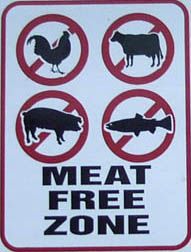
Global food movements making a difference: PLANT-BASED DIETS

"Eat less meat." That was the essence of the message by Dr. Rajendra Pacauri, chair of the United Nations Intergovernmental Panel on Climate Change in September. While the comments by this Nobel Peace Prize recipient may be "the most controversial yet," they represent one of the most practical things individuals can do to tackle global warming. [38] "In terms of immediacy of action and the feasibility of bringing about reductions in a short period of time, it clearly is the most attractive opportunity," Pacauri said. "Give up meat for one day [a week] initially, and decrease it from there."

The comments by this vegetarian bear testimony to another global food movement - plant-based diets, which include Vegetarianism, Veganism, Raw/Live Foodism, and Fruitarianism. [39] Each has received increased attention as a sustainable dietary choice, which has health benefits personally and environmentally.

Though the history of plant-based diets is a long one, John Robbins brought it to the forefront of the American conscious in 1987 with his book, Diet For A New America. Now an international bestseller, the book clearly presents how food choice affects personal health and happiness, but also the future of life on the earth. By detailing health risks of meat consumption, corruption in food production, and animal abuses in the food industry, he advocates for a plant-based, vegan diet, and has inspired many to eat less (if any) meat.

Robbins drew much attention to himself and to his first book as the only son of Irving Robbins of the Baskin-Robbins ice cream empire. Though groomed to follow in his father's footsteps, he chose to walk away from the company and the immense wealth it represented to "pursue the deeper American Dream. . . the dream of a society at peace with its conscience because it respects and lives in harmony with all life forms. A dream of a society that is truly healthy, practicing a wise and compassionate stewardship of a balanced ecosystem." [40] While Robbins really gave credibility to the growing vegan movement, he also re-started the vegetarian movement in the United States. [41]

The history of plant-based diets is really as old as history, and rooted in all religious and philosophical traditions. [42] In terms of human anatomy, some doctors are advancing the physiological facts that humanity was created as natural herbivores, not carnivores. [43] This is confirmed in the creation story of the Judeo-Christian faith where a plant-based diet is prescribed for humans and for animals in Genesis 1:29-30, with the harmonious co-existence of humanity and the environment being deemed by the Creator as "very good" (1:31).

Among religious groups in Egypt around 3200 BC, a vegetarian ideology was practiced with abstinence from flesh based upon karmic beliefs in reincarnation. Abstention from meat was also central to such early religions as Hinduism, Buddhism, Zoroasterianism, and Jainism, which all hold doctrines of non-violence and respect for all life forms. While wishing to avoid animal cruelty, philosopher and mathematician Pythagoras encouraged vegetarianism as a key factor in peaceful human co-existence, putting forward the view that slaughtering animals brutalized the human soul. He also saw the health advantages in a meat-free diet.

Other ancient Greek thinkers, Socrates, Plato, and Aristotle also favored a vegetarian diet and advocated a "natural" life that did not involve animal cruelty. Though such ideals found very limited sympathy within the brutality of Ancient Rome, vegetarianism spread throughout the Roman Empire from the 3rd to 6th centuries among those influenced by Neo-Platonist philosophy, a progression from the teachings of Plato.

In the east and in the west, history clearly reveals that plant-based diets have nourished and sustained cultures all over the world for thousands of years. However, Manchester, England in 1815 is often regarded as the birthplace of the current vegetarian movement. [44]

Next week:
History of the current vegetarian movement

[38] Juliette Jowit, "UN says eat less meat to curb global warming," Guadian.co.uk, http://www.guardian.co.uk/environment/2008/sep/07/food.foodanddrink (accessed September 20, 2008).
[39] Veganism, Raw/Live Foodism, and Fruitarianism share roots with the Vegetarian movement. Due to limited space, only the history of Vegetarianism will be presented in this paper. Each, however, like Vegetarianism, developed first in Europe before influencing the dietary choices of Americans.
[40] "About John Robbins," Food Revolution, http://www.foodrevolution.org/bio.htm (accessed December 17, 2008).
[41] Michael Bluejay, "A History of Vegetarianism," Vegetarian Guide, http://michaelbluejay.com/veg/history.html (accessed December 17, 2008).
[42] Portions of this history are from "21st Century Vegetarians - Through the Ages," The Vegetarian Society UK, http://www.vegsoc.org/news/2000/21cv/ages.html (accessed December 14, 2008),
[43] Milton Mills, "Are Humans Designed To Eat Meat?" (2007), VegSource http://www.vegsource.com/articles2/mills_07.htm (accessed December 17, 2008).
[44] "Shaker-makers! Manchester Originals," International Actuarial Association - Manchester, http://www.actuaries.org/ASTIN/Colloquia/Manchester/Manchester_Originals.pdf (accessed December 17, 2008).

Saturday, February 7, 2009

Don't Get Mad, Get GLAD: Organic Farming

This is part 5 of my research on global food movements entitled
GLOBALIZATION: It's what's for dinner

Global food movements making a difference:
ORGANIC FARMING


Though One Planet Living is not specifically a global food movement, it exemplifies one of the most important principles in other movements - sustainability. Sustainability is defined as “meeting the needs of the present without compromising the ability of future generations to meet their own needs," [19] and nowhere is it more evident today than in the organic farming movement which has also been referred to as sustainable agriculture.


In the largest known survey of worldwide sustainable agriculture, Pretty and Hine note that sustainable agriculture, which is now a financially feasible option for farmers, makes "the best use of nature’s goods and services as functional inputs." [20] By integrating natural and regenerative processes, it minimizes the use of non-renewable inputs of conventional farming (pesticides and fertilizers), which are now known to damage the environment and harm the health of the farmer and the consumer.

During the first 40 years of the 20th century, advances in biochemistry and engineering rapidly and profoundly changed farming in industrialized countries. Gas-powered vehicles, mechanized farms, hybrid seeds, and nitrogen fertilizer were embraced and became affordably abundant and developed for the conventional farming system. Technological advances during World War II accelerated all aspects of agriculture, with advances in large-scale irrigation, fertilization, and pesticides. In particular, two chemicals, ammonium nitrate and DDT, were repurposed for peacetime agricultural uses.

In 1944, the international campaign called the "Green Revolution" changed the face of farming practices around the world through the use of hybrid seeds, which were fed by chemical fertilizers, protected by pesticides, and harvested through large-scale irrigation and heavy mechanization in single crop farms. Beginning in Mexico with private funding from the US, traditional indigenous practices were soon replaced by a dependence on multinational corporations for supplies.

Agricultural diversity and local seeds would eventually be lost as farmers in the developing world bought the promise of better crops and increased revenue. Though there was initial success, over time soil nutrients were depleted; crops required more poison for protection and production; harvests produced less as the food quality declined. Within this farming climate the fast food movement took root in the US during the 1950s, and internationally beginning in the 1960s.

In their book, Hope's Edge, Frances Moore Lappé and daughter Anna tell the story of Navdanya, a movement in India, which, according to one of its leaders, "wants to retrieve indigenous food and drink from extinction through pleasure - and fast, before our taste buds are completely stolen by Pepsi and Coke." [21] According to the Lappés, Navdanya fears that Indians are being "sucked into this radical, experimental diet - the one spreading from America to the rest of the world, bringing with it heart disease, cancer, and diabetes." [22]

Farmers in India like those in Mexico bought into the Green Revolution and have been paying the consequence in terms of human health, environmental damage, and financial losses ever since. By empowering farmers with knowledge and skills, and reintroducing native seeds and resources to off-set the five to seven year transition as the soil is rebuilt, Navdanya is now changing the lives of farmers and communities through organic, indigenous farming practices and crops that were nearly lost.

How ironic that as India today reclaims its agricultural heritage, India a century ago is where the roots of the modern organic farming movement began. Conscious organic farming (as opposed to the agriculture of indigenous cultures, which "always employs only organic means," which Wikipedia correctly notes) began in the early 1900s through Rudolf Steiner's first comprehensive organic farming system in Germany in 1924, and the research by British botanist Sir Albert Howard who came to regard Indian farming practices as superior to conventional agriculture science. [23]

According to William Tate in 1994, there are three main phases of the international organic movement: (1) 1924-1970 = Struggle and financial difficulty as core works were written amid a hostile environment due to the rise of new conventional farming practices; (2) 1970-1980 = Key organic symbols were established, the International Federation of Organic Agriculture Movements was founded (1972), 'green' awareness grew, and retailer outlets multiplied as customer awareness of the risks in conventional farming were raised and organic demand increased; and (3) 1980 on = Popular acceptance as national and international standards were set and governments introduced organic aid schemes for farmers. [24]

In their 2001 study, Pretty and Hine note, however, that though there has been "a very rapid spread" of sustainable agriculture in the last decade and considerable global recognition of the need for policies, in most countries, organic farming remains in the margins. [25] Only Cuba and Switzerland have given explicit national support for sustainable agriculture.

In the United States, organic farming is recognized as one of the fastest growing segments in U.S. agriculture with the market for organic products expanding and expected to continue its expansion as consumers are becoming increasingly aware about conventional farming and its impact on human health due to pesticide residues, and environmental health due to the loss of wildlife species and natural habitats, and rise of pollution and non-renewable resources. Michael Pollan’s poular 2006 book on organic agriculture, The Omnivore’s Dilemma, has also raised awareness about the realities in the industry.

Nationwide, organic food sales have grown 20 percent annually in the last eight years due to consumer demand. [26] In their book, the Lappés also tell the story of a Wisconsin farmer who transitioned to organic practices from farm chemicals which he says killed his father. "Consumers are smarter now," he says. "Once a week there's something in the paper about what's going on - hormones, pesticides, resistance to antibiotics. So the big food chains are responding. They are working with us to get organics into their stores. . . . because consumers have a vote and they're using it." [27]

Next week:
Other sustainable food movements

[19] "Sustainability," United States Environmental Protection Agency, http://www.epa.gov/Sustainability/ (accessed December 16, 2008).
[20] Jules Pretty and Rachel Hine, "Reducing Food Poverty with Sustainable Agriculture," Centre for Environment and Society, University of Essex, UK, http://www.essex.ac.uk/ces/esu/occasionalpapers/SAFErepSUBHEADS.shtm (accessed December 16, 2008), 11.
[21] Frances Moore Lappé and Anna Lappé, Hope's Edge: The Next Diet for a Small Planet, First Trade paperback edition 2003 (New York: Jeremy P. Tarcher/Putnam, 2002, 148.
[22] Ibid., 148.
[23] "History of organic farming," Wikipedia, http://en.wikipedia.org/wiki/History_of_organic_farming (accessed December 16, 2008).
[24] William B. Tate, "The Development of the Organic Industry and Market: An International Perspective," in The Economics of Organic Farming: An International Perspective, ed. N.H. Lampkin and S. Padel (Oxon, UK:CAB International, 1994), 11.
[25] Pretty and Hine, 21.
[26] cf. Lappé and Lappé, 270 and "History of organic farming," Wikipedia.
[27] Lappé and Lappé, 270.